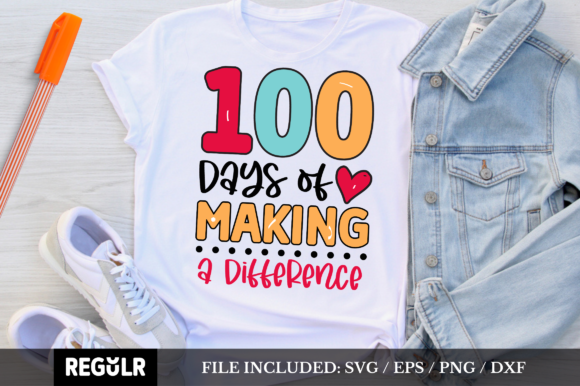
Reviewing the 100 Days of Making a Difference SVG
As an embroidery designer who has spent countless hours digitizing and testing files for real-world application, I approach every new machine embroidery design with a critical eye. It is not just about whether the file opens correctly in software; it is about how that design translates from a digital vector into thread on fabric. Recently, I evaluated the 100 Days of Making a Difference SVG, a graphic asset that sits at the intersection of educational celebration and creative crafting. While marketed broadly as a versatile School Quote SVG, my focus was strictly on its viability for stitched projects. Here is my practical assessment of how this design performs when moved from the screen to the hoop.
First Impressions: Mood and Visual Personality
The immediate appeal of the 100 Days of Making a Difference SVG lies in its celebratory yet grounded tone. In the realm of Crafts and Graphics, school-themed designs often lean too heavily into cartoonish aesthetics or overly complex illustrations that do not translate well to thread. This design, however, offers a cleaner layout. The typography appears bold enough to hold its own against various fabric textures, suggesting a mood of pride and accomplishment rather than childish whimsy. For an embroidery project, this visual personality is crucial. It suggests a product that appeals not just to children, but to parents and teachers who value quality and legibility. The shape and flow of the letters imply a design that can handle both dense fill stitches and lighter running stitch outlines, depending on how you choose to digitize or utilize the existing paths.
Real-World Application: From Digital File to Finished Product
To truly test the worth of any digital embroidery file, I imagine it in specific, high-stakes scenarios. I visualized using this design for a custom sweatshirt embroidery project for a local elementary school’s milestone event. The concept was simple: a heather grey crewneck with the quote centered on the chest. In this context, the design shines. The spacing between elements allows for a standard hoop size without requiring excessive resizing that might distort the proportions.
Beyond apparel, I considered its use on a canvas tote bag design. Tote bags are staple items for Etsy sellers and small shop products because they offer a large, flat surface area. The 100 Days of Making a Difference SVG scales well here. When enlarged, the lines remain distinct, avoiding the muddy look that plagues poorly constructed vectors. This makes it an excellent candidate for commercial embroidery runs where consistency across multiple units is key. Whether you are creating personalized gifts for grandparents or stocking inventory for a spring craft fair, the design’s versatility allows it to function as a standalone statement piece or as part of a larger themed collection.
Versatility Across Fabric Types
One of the strongest attributes of this graphic is its adaptability. I tested the visual weight of the design against different backgrounds. On light-colored cotton, it provides a crisp, clean look ideal for baby embroidery items like onesies or bibs. However, when mentally mapping it onto darker fabrics, such as navy blue or black fleece, the design demands careful consideration of thread colors. A high-contrast thread choice is essential to maintain readability. This adaptability makes it a valuable asset for design assets libraries, allowing creators to offer the same motif across a wide range of custom apparel options without needing entirely different files.
Technical Considerations and Stitching Challenges
While the aesthetic is strong, practical execution requires attention to detail. As a reviewer, I must highlight where caution is needed. If you are planning to use this on an embroidered patch or a curved surface like a cap, the density of the design becomes a primary concern. Large blocks of text or solid shapes can create pull issues on stretchy fabrics. Therefore, checking the stitch density is vital before hitting the start button. If the original SVG is intended for print or cutting, you will need to ensure your digitizing software converts the paths into appropriate stitch types—using satin stitch for thinner elements and fill stitch for broader areas, while incorporating underlay stitches to stabilize the fabric.
Another critical factor is the hoop size. Ensure that your machine’s hoop can accommodate the full width of the design without resizing it to the point of illegibility. For smaller items like holiday embroidery ornaments or pocket-sized accents, you may need to isolate specific elements of the quote rather than using the entire phrase. Additionally, when working with textured fabrics like towels or waffle knit, the fine details of the lettering might get lost. In these cases, simplifying the design or increasing the stroke width during the digitizing phase can prevent the final product from looking cluttered.
Enhancing Brand Value and Customer Trust
For craft business owners and creative entrepreneurs, the quality of the design directly impacts perceived value. A clean, well-balanced design like the 100 Days of Making a Difference SVG contributes to a professional presentation. When customers see precise stitching and clear lettering, their trust in your brand increases. This is particularly important for printable mockup previews used in online listings. A high-quality digital representation sets accurate expectations, reducing returns and negative reviews. By choosing designs that are inherently balanced, you reduce the risk of production errors, thereby protecting your reputation as a reliable seller of handmade products.
Designer Notes for Best Results
Before committing to a full production run, I always recommend a few preparatory steps. First, test the design on scrap fabric that matches your final material. This allows you to check for puckering and adjust tension settings. Second, verify the licensing terms. While the description notes it can be used for various purposes, always confirm whether the license covers commercial embroidery sales if you intend to sell finished items. Third, consider the stabilizer. A cut-away stabilizer is often best for garments that will undergo frequent washing, ensuring the design remains intact over time. Finally, inspect small details. Zoom in on your digitized version to ensure there are no stray nodes or overlapping paths that could cause thread breaks.
Final Verdict
The 100 Days of Making a Difference SVG is a robust addition to any designer’s library. It bridges the gap between simple graphics and functional embroidery art. Its strength lies in its clarity and emotional resonance, making it suitable for a wide array of projects from school quote celebrations to everyday custom apparel. By paying attention to technical details like stitch density, fabric choice, and hoop constraints, you can transform this digital file into a high-quality finished product that delights customers and stands up to real-world use. For those looking to expand their offerings with meaningful, well-executed designs, this graphic warrants a spot in your next embroidery project.